
Back · Lay · Exposure
FairPlay Exchange — Official 2% Commission Board Where Members Set the Price
To trade on FairPlay exchange, sign in, open a market and pick a side: Back if you think the outcome lands, Lay if you think it won't. Another user takes the opposite position. Your worst case shows as exposure before you confirm, and FairPlay keeps 2% of net winnings, nothing on a loss.

FairPlay Exchange Back and Lay, Made Clear on One Real Board
Open any market on FairPlay exchange and each price can be clicked from two directions. One direction is for people who expect the result. The other is for people who'd wager it misses, and if you click from that end, you are the one paying out when you're wrong. Nobody at FairPlay fixes those numbers; they are whatever other users are asking for and offering at that moment, which is why they jump around when a wicket falls.
Two verbs. That is most of what you need.
Backing a price on FairPlay exchange
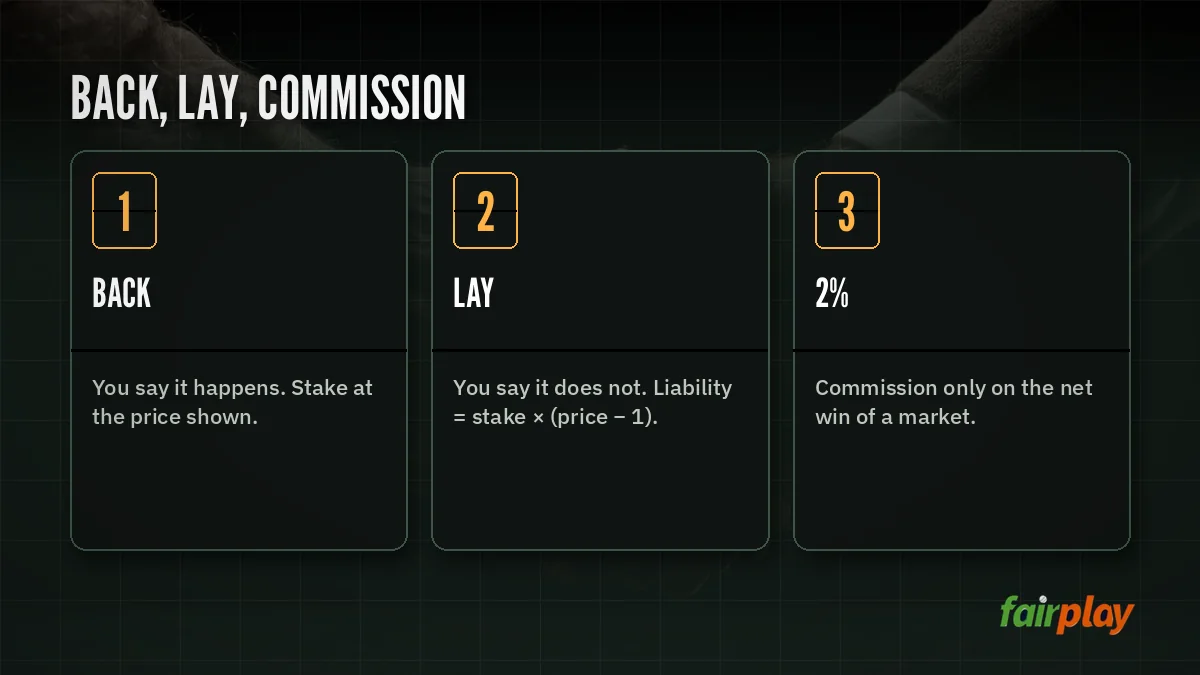
Backing is the side everyone already knows from from a sportsbook. Put ₹1,000 on a side at 2.50 and a win returns ₹2,500: your own ₹1,000 plus ₹1,500 of profit, of which FairPlay keeps 2%. If the side loses, the ₹1,000 is gone. That stake is the ceiling on what a single back bet can ever cost you on FairPlay, however long the odds.
Laying the same price
Lay is the column that confuses newcomers, mostly because the number in the stake box isn't the number at risk. When you lay on FairPlay, the stake you type is what the other user stands to lose to you. What you can lose to them is their profit: at 1.40 that's ₹0.40 for every ₹1 they stake, at 8.0 it is ₹7 for every ₹1. So a ₹200 lay at 8.0 puts ₹1,400 on the line to win ₹200 (this is the part people skip over, every time). Think of it as running a tiny book on one outcome, with exactly one customer.
- You type
- Lay at 3.20, stake ₹400.
- FairPlay shows
- Liability of ₹880, before anything is confirmed.
- Someone backs it
- The ₹400 lay is matched; ₹880 of your balance is now on the line.
- Side loses
- ₹400 comes to you, less the 2% fee, so ₹392.
- Side wins
- ₹880 goes across to the user who backed it.
A worked example at 2.50, traded both ways
Say the FairPlay board shows a side at 2.50 and you have ₹1,000 to work with. The figures below are an illustration of the maths, not a quote for any real match.
| Position | If the side wins | If the side loses | Exposure shown |
|---|---|---|---|
| Back ₹1,000 at 2.50 | +₹1,500, so ₹1,470 after 2% | −₹1,000 | ₹1,000 |
| Lay ₹1,000 at 2.50 | −₹1,500 | +₹1,000, so ₹980 after 2% | ₹1,500 |
Same price, same ₹1,000, completely different shape of risk. Backing caps your loss at the stake and leaves the upside open; laying caps the win at the backer's stake and parks the bigger number on the loss side. Neither is safer in general. It depends entirely on the odds you are trading at, which is why the exposure figure on FairPlay matters more than the stake box does.
Placing a back or lay bet on FairPlay, step by step
- Get onto the trading board with the same credentials you use everywhere else on the site; a forgotten password is a FairPlay login page problem, not an exchange one.
- Open a market. Most people begin with cricket match markets on FairPlay — a natural first market for a new trader.
- Choose a price from the Back side or the Lay side of that market.
- Put in an amount (₹400 in the lay walk-through above) and wait a beat: on the lay side FairPlay prints the matching liability, ₹880 at 3.20, and that is the number to judge.
- Check the exposure figure, then confirm. If nobody has taken your price yet, it stays unmatched until someone does or until you cancel it.
A familiar scene. Someone lays a side at 4.0 for ₹500, expects to risk ₹500, and the exposure line says ₹1,500. Nothing is broken; that's the lay maths doing exactly what it promised.
People also search
FairPlay Exchange Words You Will Meet — Clear Notes for New Traders
What fairplay exchange points to on this page
People who search fairplay exchange usually want the board where users trade prices with one another, not the fixed-odds FairPlay sportsbook. This page sticks to that board: backing, laying, the 2% charge on net winnings and how exposure gets shown before a bet goes in.
| Term | What it means on the FairPlay exchange |
|---|---|
| Back | Stake on an outcome happening |
| Lay | Take someone's back bet; you win if the outcome fails |
| Liability | What a lay can cost you: stake × (odds − 1) |
| Exposure | The most you could lose on a market right now |
| Commission | 2% of net winnings, nothing charged on a loss |
| Matched or unmatched | Taken by another user, or still waiting for one |
Where the trading board sits next to live and high-stake play
The exchange runs on the same FairPlay ID and the same wallet as everything else on the site, so nothing needs opening twice.
Trading while a match is in progress has its own page at FairPlay Live in-play prices, and accounts that want bigger stakes on their lays are covered by the FairPlay Pro high-limit tier.
FairPlay Exchange Commission and Exposure — Real Numbers Before You Confirm
How the 2% FairPlay exchange fee is worked out
The charge comes off net winnings and nothing else. Lose, and there's nothing for FairPlay to take 2% of. Win ₹1,000 net and ₹20 goes as commission, leaving ₹980 in your balance. Small, sure. It does add up if you trade lots of thin margins, so build it into your sums before you place anything rather then after.
Net matters most when you hold both sides of one outcome. Suppose you backed at 3.0 for ₹500 early on and later laid the same outcome at 2.2 for ₹600. If it lands, the back pays +₹1,000 and the lay costs −₹720, so you're up ₹280 and the fee is ₹5.60. If it fails, the back loses ₹500 and the lay earns ₹600: up ₹100, fee ₹2. Green either way. That, at least, is how a net figure normally works out; the settled line on your FairPlay statement is the final word on any single market.
Reading FairPlay exchange exposure
Exposure on FairPlay is one number per market: the deepest hole your current bets could leave. Go back to the ₹400 lay at 3.20, which carries ₹880 of exposure on its own. Now add a ₹300 back on the same side at 3.20. If the side wins, the lay costs ₹880 but the back returns ₹660, so you're down ₹220. If it loses, the lay brings ₹400 and the back drops ₹300, so you are up ₹100. The worst case has fallen from ₹880 to ₹220, and that smaller figure is what the board now reports.
It is money already committed. So when your available FairPlay balance looks lower than you expected halfway through a match, open exposure before you assume anything has gone wrong; more often than not, that is where the difference sits.
When a FairPlay exchange bet doesn't behave as expected
Still unmatched. Your price is better than anyone on the other side is willing to take. You can wait, move the price toward what the FairPlay board is already showing, or cancel. An unmatched stake has not been risked yet.
Only part matched. Say ₹1,000 went in and the FairPlay board shows ₹620 matched: that slice is live, the other ₹380 is still an offer nobody has taken. Read the matched figure, not the stake you typed, before the first ball goes down.
Exposure far above the stake. Long odds on the lay side, almost certainly. At 6.0 a ₹500 lay already means ₹2,500 at risk on FairPlay, so pick a shorter price or a smaller amount and watch the figure shrink before you commit.
Winnings smaller than the sum you worked out. FairPlay takes its 2% when the market settles, so a ₹1,500 gross win lands as ₹1,470.
Once a market settles, the money sits in the same wallet you use for withdrawals; payout timing is set out on the FairPlay withdrawal time page, and if you still need an account the FairPlay ID page covers how one is issued.
FairPlay Exchange Doubts Cleared — Easy Answers on Back, Lay and Fees
What is FairPlay exchange?
Think of it as a two-sided price board. One FairPlay member offers 2.50 on India, another takes it, and the two stakes settle between them at the final ball. FairPlay keeps 2% of whoever nets a profit on that market, which is why its prices sit tighter than a fixed-odds coupon.
What is the difference between back and lay on FairPlay?
The difference is which side carries the bigger number. On FairPlay at 2.50 with ₹1,000, a backer can lose ₹1,000 or win ₹1,500, while a layer can win ₹1,000 or lose ₹1,500. Back when you expect the result to happen; lay when you expect it to miss.
How much commission does FairPlay exchange charge?
Two percent, and only on what you net. On FairPlay exchange a market that finishes ₹1,000 up costs ₹20, one that finishes ₹350 up costs ₹7, and one that finishes down costs nothing, because there is no net win for the fee to come out of.
What does exposure mean on FairPlay exchange?
Exposure is your worst possible result on one market, given every bet you hold there right now. FairPlay displays it before you confirm a new bet. Lay ₹400 at 3.20 and it reads ₹880; add a ₹300 back at the same price and it drops to ₹220, since the two positions offset.