
Toss · Session · Fancy
FairPlay Cricket — Top Toss and Fancy Prices to Read Before Each Session Bet
To read the toss, session and fancy prices for a match, sign in to FairPlay cricket with your ID and open that fixture. A T20 carries about 55 markets in four rows: match odds, toss, session runs and fancy. IPL nights, internationals and domestic T20s share one board and one wallet.

People also search
FairPlay Cricket Essentials — Clear Answers Before the First Over
Where the FairPlay cricket ID gets typed on this board
Nothing new to create for sport. Whatever ID the FairPlay desk sent you doubles as the cricket ID, typed into the card above or on the FairPlay login page, and cricket shares its balance with the dealer rooms and the crash round.
What a FairPlay cricket betting id opens once it is active
People search for it as a cricket betting id, a cricket ID or plainly a FairPlay account, and all three mean the same login. On a T20 it shows around 55 lines: who wins, who calls the toss, runs inside set blocks of overs, and fancy lines on batters, partnerships and single overs.
IPL FairPlay fixtures compared with the rest of the calendar
An IPL FairPlay match carries the same four families as an international or a domestic T20, so nothing about the board changes in April. What changes is frequency. In season there is a game most evenings, and on double-header days two of them back to back, which is when most people want the fixture search to be quick.
Order of play for fairplay cricket on a match day
- Sign in with the FairPlay cricket ID through the card above.
- Open the fixture from the cricket list and wait for its markets to load.
- Check the toss price first, since it is the earliest line to close.
- Follow session and fancy lines innings by innings.
- Settle up, then request the payout from the withdrawal screen.
FairPlay Cricket Markets — the Real 55-Line Menu on One T20
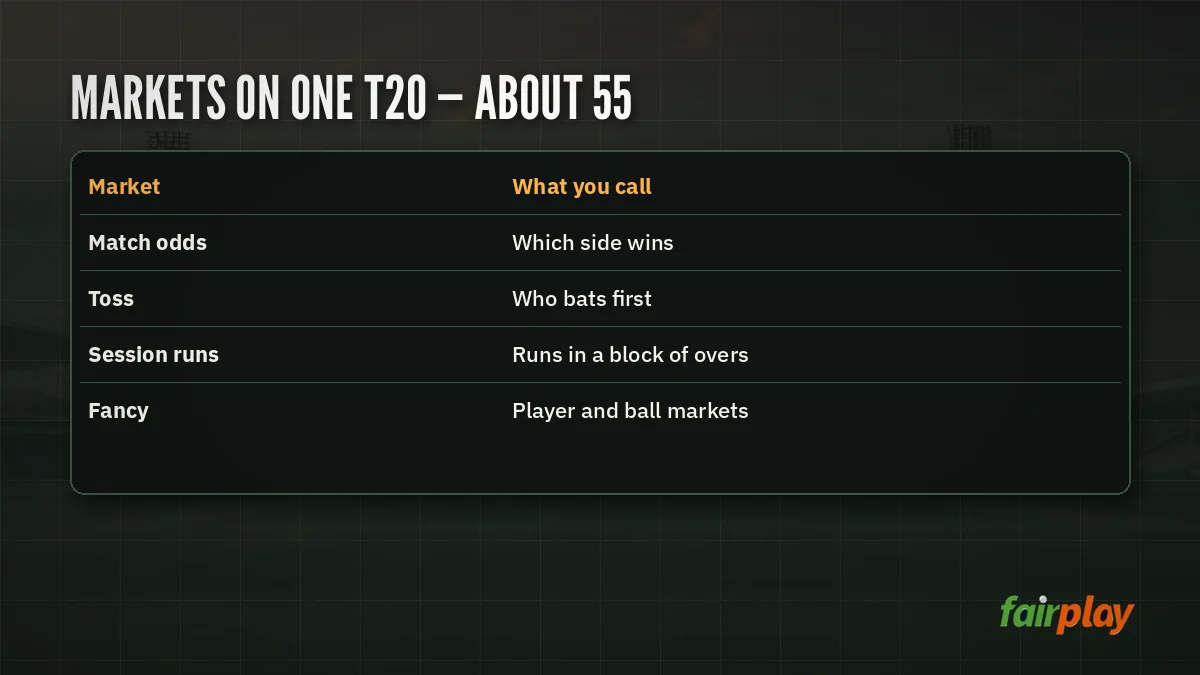
Fifty-five. That is roughly how many markets FairPlay hangs on a single T20 fixture, and the figure tends to surprise people arriving from a bookmaker that shows a winner price and very little else.
They fall into four families. Everything on the FairPlay cricket board belongs to one of them, which makes the long list less intimidating than it looks on the first scroll.




| Family | Settles on | When it is usually open | How to read it |
|---|---|---|---|
| Match odds | The result of the fixture | Before the toss and through most of the game | One price per side; the shorter price is the side the market expects |
| Toss | Which captain wins the call | Only until the coin goes up | Near-even on both teams, almost always |
| Session runs | Runs scored inside a set block of overs | Opens per block, can pause when a wicket falls | Two figures, a lower No and a higher Yes |
| Fancy | One batter, one partnership or one over | Some before the start, most during play | Yes/No line, read the same way as a session |
Match odds on FairPlay, the line most people start with
Suppose a side slips to 30 for 3 inside the powerplay. On FairPlay its match-odds price lengthens within moments, and a fifty stand afterwards pulls it back in. That pair of prices, one per team, is the whole market, and it settles on the final result. Laying a team rather than backing it is possible because the board runs on a cricket exchange; the FairPlay exchange page has the detail.
How many of the 55 lines are fancy and how many are session? We have not counted a fixed split, and probably there isn't one. A headline IPL fixture tends to carry more player lines than a quiet domestic game, while the toss and the match result are always there. So treat 55 as a fair average for a T20 rather then a promise for every fixture.
One FairPlay cricket ID covers all four families. Nothing is unlocked separately and there is no second wallet for sport.
FairPlay Toss and Session Runs — an Easy Way to Read Each Price
Two markets cause most of the questions that reach the FairPlay desk on match nights: the toss, because it disappears so early, and the session line, because it shows two numbers where people expect one.
The FairPlay toss market and why it vanishes
The toss settles on one thing, which captain calls correctly. FairPlay lists it on the fixture well before the start and pulls it shortly before the coin is flipped. On an IPL evening the coin usually goes up about half an hour before the first ball, so that is roughly when the window shuts. Miss it and it does not come back for that match.
Prices sit close to even. That is the nature of a coin.
If weather means no toss happens at all, how the stake is handled depends on the rules each FairPlay fixture prints under it's market list, so read them once rather than guess. In practice most people only check after the fact, which is the wrong order.
Session runs: two figures, one decision
Take the first six overs as the block. Beside it FairPlay prints two numbers, the smaller marked No and the larger marked Yes. On Indian exchange boards the convention runs like this: reach the Yes number and Yes is paid; finish under the No number and No is paid. Check the FairPlay rules for that exact line before staking a rupee. A minute of reading, no more.
A worked example helps, with made-up figures that are only there to show the mechanics.
- Line shown
- First 6 overs, No 47 · Yes 49
- You pick Yes
- You are saying the team gets to 49 or more by the end of over six
- You pick No
- You are saying the team finishes the block below 47
- Score lands on 52
- Yes settles as a win, No as a loss
- Score lands on 44
- No settles as a win, Yes as a loss
- Wicket in over four
- The line may pause, then reopen at new figures
That pause is normal. When a wicket falls or a boundary changes the picture, FairPlay may suspend the session line for a moment and bring it back at different numbers, and a stake you were halfway through typing may well be rejected rather than accepted at the old figure. Re-read the line and decide again. Sessions repeat across both innings — the first block, the middle overs, the death overs — so a T20 on FairPlay offers several session decisions, not just one.
Second-innings sessions behave a little differently from first-innings ones. Once a target exists, the chasing side's required rate is on screen, and the FairPlay session figures start to lean on it: a side needing twelve an over is likely to see a higher middle-overs line than a side cruising at seven. Nothing about the reading changes. The No figure is still the lower one, Yes still the higher, and the block of overs is still printed beside the line. What changes is how fast the numbers move after a boundary, which in a tight chase can be several times in one over.
Most of the 55 lines on a FairPlay fixture are some version of this same yes-or-no reading. Learn it on the session market and the fancy list below reads almost the same way.
FairPlay Fancy Lines — a Trusted Read on Player and Partnership Bets
Most of the 55 lines live here. A fancy line on FairPlay narrows the question to one player or one moment: a named batter's score, how long the current pair lasts, the runs off over fourteen, now and then a bowler's spell.
The display is the session layout again, a No figure and a Yes figure, so anyone who has read a session line on FairPlay already knows how to read a fancy line. The difference is what ends it. A batter's runs line settles the moment that batter is out or the innings closes. A partnership line settles when either partner goes.
That makes fancy lines shorter-lived than they look. Some open before the first ball on FairPlay, especially for the openers; most appear once play is under way and the board can see who is actually batting. When a new batter walks out, expect fresh lines for them within a few minutes rather than instantly.
A common one: a player backs Yes on an opener's runs line around the eighth over, the opener is caught in the ninth, and the the next message to the desk asks where the line went. Nothing went wrong. The batter's innings ended, so the FairPlay line settled on the runs he had.
Fancy lines on FairPlay are not limited to IPL. Internationals carry them, and so do domestic T20s, though a smaller fixture may list fewer of them. Hard to say exactly how many on any given night, which is one more reason the 55 figure is an average.
Single-over lines are the quickest of the lot. They open before the over starts and settle once it is bowled, often inside four minutes. Whether wides and no-balls count toward that over's total is written in the settle note on the FairPlay line, and that note decides it, not habit carried over from some other site.
If a fancy line looks frozen, it is probably suspended between deliveries, not broken. Give it a few seconds before reloading the fixture.
Three habits make the fancy list easier to use. First, open the fixture early enough to see which lines are already up, because the pre-match fancy set on FairPlay is smaller and calmer. Second, keep an eye on the scorecard alongside the board; the line only makes sense against who is batting and how many balls remain. Third, read the settle condition on any line you have not used before — a bowler's line, for example, may count something different from what the label suggests at first glance.
IPL FairPlay Season — a Quick Match-Night Routine and Fixes
For roughly two months each spring the FairPlay cricket board runs on IPL time. Evening starts dominate, Sundays often bring two games, and the stretch from the toss to the end of over six is when the screen moves fastest.
Here is the routine that works for an IPL FairPlay evening. It is not clever. It just puts things in the order the board opens and closes them.
- About an hour before the start, sign in with the FairPlay cricket ID and check the wallet. If it needs a top-up, the amounts and the first-deposit figure sit on the FairPlay cricket ID page.
- Open the fixture and look at the full list once, before anything moves, so you know which fancy lines are already up.
- Decide on the toss early. It closes first and does not reopen.
- Watch the first session block of the innings. That is where the most lines open at once.
- Between innings, check the second-innings session lines as they appear on FairPlay; the chase changes the figures quickly.
- After the result settles, request any payout from the withdrawal screen. Timings are covered on the FairPlay withdrawal time page.
On busy evenings the usual address can be slow, especially right as the toss market closes. The cricket board is the same on the FairPlay Live mirror address and on the FairPlay Pro address, with the same ID and the same balance, so switching costs nothing but a sign-in.
One IPL evening on FairPlay, from toss to result
Timings below are for a standard 7:30 PM IST start and are approximate; a rain delay or a long innings shifts everything. The point is the order in which the FairPlay cricket board opens and shuts its lines.
| Around | What happens on the field | What the FairPlay board is doing |
|---|---|---|
| 6:30 PM | Teams warming up | Match odds and toss already listed, a few opener fancy lines |
| 7:00 PM | Toss | Toss line gone; teams named, more fancy lines appear |
| 7:30 PM | First ball | Opening session block live, prices start to move |
| 8:00 PM | Powerplay over | Middle-overs session line, partnership fancy |
| 9:00 PM | Innings break | Chase sessions begin to open for the second innings |
| 11:00 PM | Result, roughly | Lines settle; balance updates in the wallet |
Two things stand out from that list. The busiest stretch is short, about the forty minutes from the toss to the end of the powerplay, and anything decided before 7:00 PM is decided calmly. On a double-header Sunday the afternoon game runs the same pattern four hours earlier, so it is easy to be on FairPlay for one match and miss the toss of the next.
When a FairPlay cricket bet does not go through
Rejected stakes are almost always one of four things, and it helps to check them in this order:
- Line suspended
- A wicket, a review or a boundary paused the market; wait and re-read the new figures on FairPlay.
- Stake under the floor
- The bet slip shows the minimum for that line; raise the amount to it.
- Wallet short
- The balance does not cover the stake; top up first.
- Session timed out
- Sign in again through the FairPlay login page and reopen the fixture.
If none of those fits, the desk can look at the bet from its side. Shift hours and the number are on the FairPlay customer care page; send the fixture name, the market and the time you tried, because that is what they will ask for first anyway.
FairPlay cricket outside the IPL months
The board does not go quiet when the IPL ends. Internationals and domestic T20s keep the FairPlay cricket list busy for most of the year, with the same four families and roughly the same shape. Start times move around more, though: a series abroad might mean a morning or a late-night start in India, which matters for the toss window because it closes before play wherever the match is. If you only play one league, check its fixture time in IST before sitting down — it's the single most common reason people miss a toss line.
Prefer a phone at the ground or on the sofa? The FairPlay app carries the identical fixture list, and its install steps are on the FairPlay app page.
FairPlay Cricket Questions — Quick, Clear Answers on Markets and Stakes
How does cricket betting work on FairPlay?
You sign in with your FairPlay ID, open a fixture and place a stake on one of roughly 55 markets for that T20, from match odds to the toss, session runs and fancy lines. Each market settles on its own event, and any winnings return to the same wallet you use for everything else.
What is a fancy market in FairPlay cricket?
A fancy market is a yes-or-no line on one smaller part of a match, such as a batter's runs, a partnership or the runs in a single over. FairPlay shows a No figure and a Yes figure, and the line settles as soon as that batter, partnership or over is finished.
How do session runs work on FairPlay?
Session runs ask how many runs a team makes inside a fixed block of overs, such as the first six. FairPlay shows a lower No figure and a higher Yes figure; Yes wins if the total reaches the Yes number, and No wins if it stays under the No number. Check each fixture's rules first.
Can I bet on IPL matches with FairPlay?
Yes, IPL is covered, and a headline IPL game usually carries more player fancy lines than a quiet domestic T20 on FairPlay, while match odds, toss and session runs are listed for every fixture. The figure of 55 markets is an average across T20s, so one marquee night may show a few more than another.
How do I get a FairPlay cricket ID?
You get a FairPlay cricket ID by requesting one from the FairPlay desk through the sign-up link on this page. The same ID opens cricket, the dealer rooms and the crash game, with one balance. Timing and the first top-up amount are listed on the FairPlay ID page of this site.
What is the minimum stake on FairPlay cricket?
The minimum stake appears on the FairPlay bet slip for each market before you confirm, and it can differ from one line to another. Open the market, type a small amount and the slip will tell you if it sits below the floor. The first wallet top-up is a separate figure from the stake minimum.